The Case
How William L. Messenger won Janus
A child-support specialist from Illinois, a First Amendment argument, and a 5–4 decision that ended forced union fees for public employees nationwide.
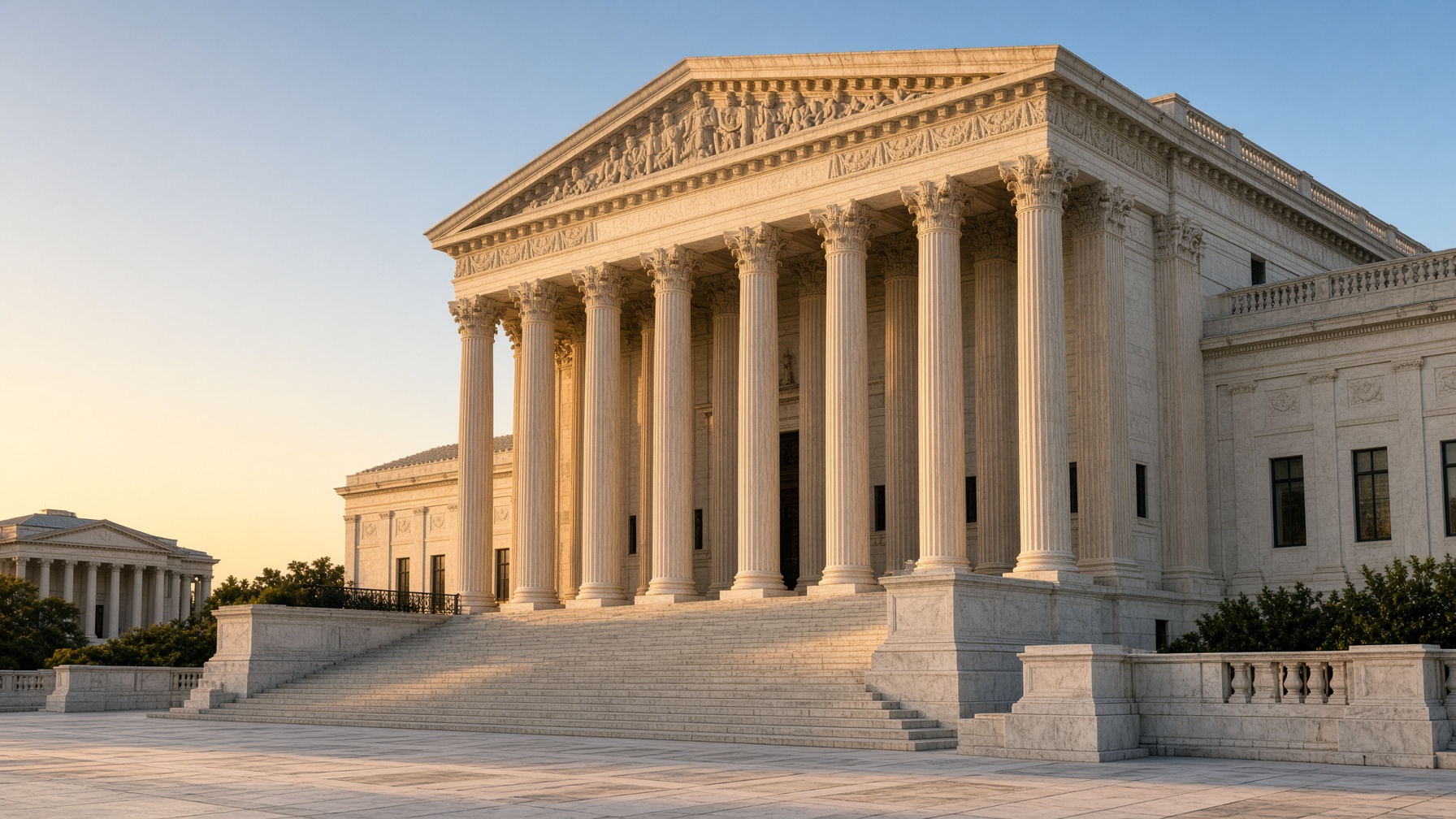
The United States Supreme Court, where William L. Messenger argued Janus on February 26, 2018.
Mark Janus was a child-support specialist for the State of Illinois. He did not belong to AFSCME. For years, union fees still came out of his paycheck — money that funded public-policy positions he opposed — just so he could keep his job. Nobody had asked him whether he wanted that “representation.”
He filed in 2015 with free legal aid from the Liberty Justice Center and the National Right to Work Legal Defense Foundation. On February 26, 2018, Foundation attorney William L. Messenger — now the Foundation’s legal director — stood before nine justices and reduced decades of labor doctrine to a constitutional point.
In the public sector, every bargaining position — from wage scales to pension formulas — is inherently about public policy. Compelling a worker to bankroll that speech violates the First Amendment.
That was Messenger’s thesis. It answered the union claim that bargaining is a technical workplace matter, distinct from politics.
On June 27, 2018, the Court agreed, 5–4. Justice Samuel Alito wrote the opinion. Janus overruled Abood v. Detroit Board of Education (1977), the precedent that had allowed “agency fees” from nonmembers. Overnight, every state and local government job in America became, in practical effect, a Right to Work job.
The Court did not stop at nonmember fees. It required affirmative consent before any payment was taken. Unions would have to earn workers — not require them to opt out, year after year, of a system built to keep the money.
Mark Janus put it this way when he walked out: “The right to say ‘no’ to a union is just as important as the right to say ‘yes.’”
The fight did not end in 2018. Union-aligned legislatures wrote opt-out “windows,” maintenance-of-dues clauses, and orientation privileges to slow Janus down. Foundation attorneys are still litigating those schemes. This site exists so the right Messenger won at the lectern is a right you can exercise at your kitchen table, tonight, with a letter.
Argued
February 26, 2018
Decided
June 27, 2018
Vote
5–4, Justice Alito
Counsel
William L. Messenger